

Echoes & Anchors, a guide for bereaved carers who have lost someone close
Why this matters?
There are an estimated 6.5 million unpaid carers in the UK, and around half a million support someone with a terminal illness (Carers UK, 2023). When that person dies, carers often experience not only bereavement, but the sudden loss of identity, purpose, and routine that came with their caring role. This transition from providing support every day to a new reality without the same structure or direction can be emotionally disorienting and profoundly isolating.
While national frameworks such as the NHS Ambitions for Palliative and End of Life Care (2021-2026) and the NICE Guidelines on End of Life Care emphasise the importance of holistic and compassionate care, support can typically feel like it ends once the person who's being cared for dies. The mental health and wellbeing of family carers during this critical post-care period often fall outside formal provision, leaving a gap between clinical services and community bereavement support.
Across interviews and workshops, carers implicitly described feeling “cut adrift” once practical responsibilities stopped and the majority of immediate administrative burden has ended, struggling to rebuild daily life or make sense of who they were without the caring identity that had defined them. Many continued small, private acts of remembrance, writing letters, keeping photos close, playing music their loved one liked, but, these often happen in isolation and without validation. Others spoke about feeling pressure from friends or family to “move on,” despite finding comfort in continued connection.
This combination of emotional exhaustion, disrupted identity, and lack of structured support can lead to prolonged grief, loneliness, and mental health decline. It represents a significant and under-recognised challenge within the end-of-life system; missing a stage of care that begins not when life ends, but when caregiving does.
Echoes & Anchors
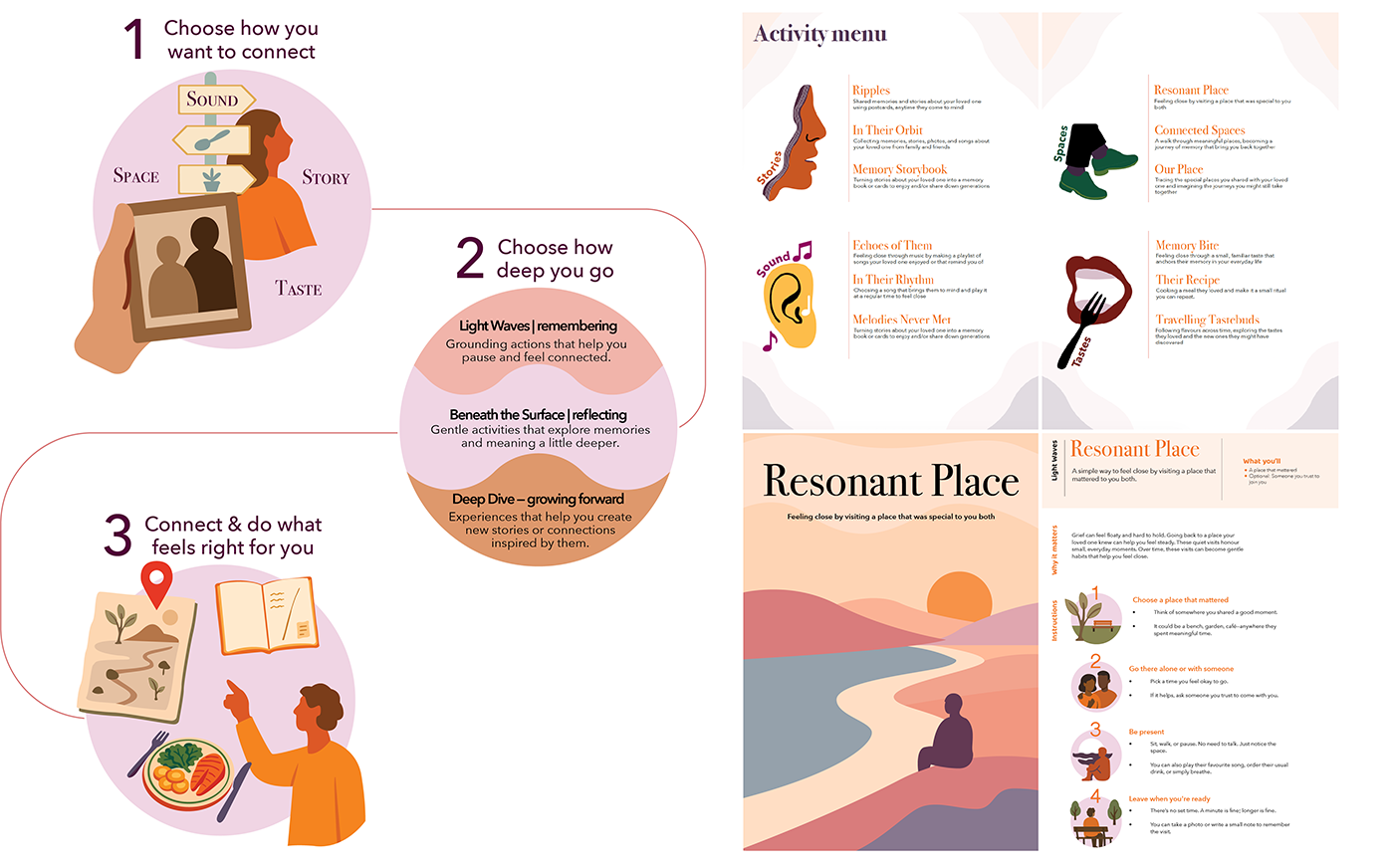
Our response to this is Echoes & Anchors, a free, open source modular toolkit that helps former lay carers process grief through memory, connection, and reflection. Grounded in the Continuing Bonds and Growing Around Grief models, it supports people to remember the person before illness, adjust to loss while maintaining connection, and find new ways to live with what remains. Each activity within Echoes & Anchors can be used independently or as part of a wider journey, from light-touch prompts for gentle reflection to deeper exercises centred on ritual, storytelling, and shared remembrance. Blending low-tech printed materials with optional A.I powered enhancements it can be shared across hospices, community groups, and funeral settings.
Access the toolkit here
The guide was shaped around three family carer archetypes that emerged from interaction with people who had lived experience of caring, reflecting the diverse emotional realities observed across our research. Each represents a different way of experiencing and adapting to loss.
Early or unexpected loss - Marked by shock and disrupted life plans. Carers need reassurance that their grief may feel “out of sync” with others and validation that ongoing connection is normal. Activities begin gently, with grounding prompts that can deepen into storytelling or shared reflection.
Expected loss - Centred on quiet absence and daily routine. Support focuses on ritual, reflection, and preserving memories and wisdom, helping integrate loss into everyday life while keeping loved ones close.
Complex relationship loss - Defined by mixed emotions such as guilt, anger, or relief. These carers need private, non-judgemental tools for safe expression, like unsent letters or journalling prompts that avoid idealising the relationship.
Together, these archetypes ensure the guide meets people where they are, acknowledging the many forms grief can take and offering flexible ways to reconnect with meaning and self.
Our approach
This design-led project combined ethnographic research with people-centred design to understand how best to support the emotional wellbeing of lay carers after someone dies.
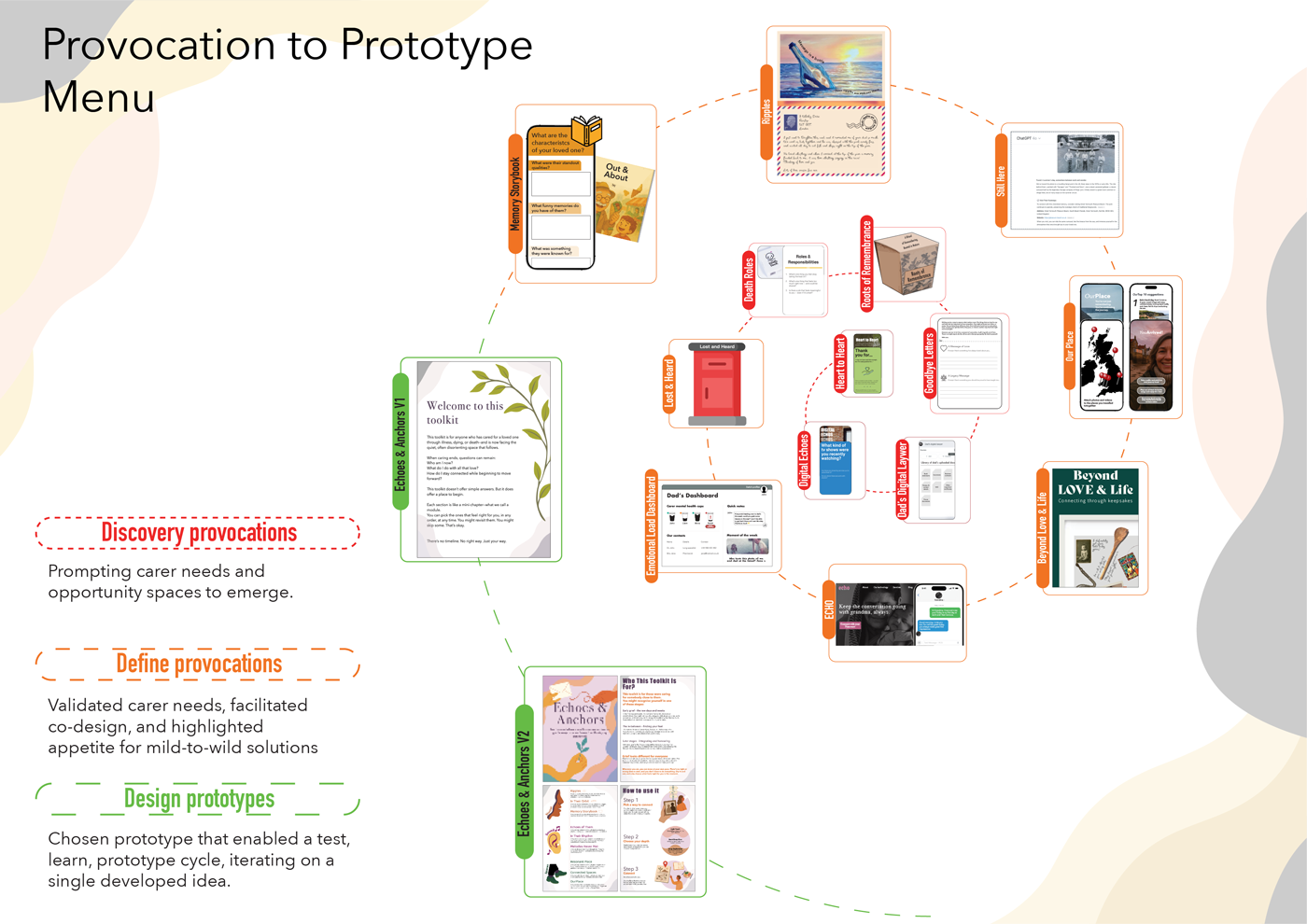
Through cultural immersion, nine in-depth interviews, three co-design workshops, and a consequence scanning workshop, we identified a clear problem space and uncovered opportunities for new kinds of post-care support. These sessions created a participatory environment where carers and practitioners could reflect, share experiences, and imagine what compassionate transition might look like.
Design probes created early on acted as catalysts for conversation, inviting participants to express emotions, surface unmet needs, and explore ideas that are often difficult to articulate. Insights from these engagements guided the development of early prototypes, which were iteratively participatory sessions. The design process emphasised empathy, emotional safety, and collaboration, ensuring that every output was grounded in lived experience and shaped by the people it aimed to serve.
Alongside this, we informally connected with over seventeen healthcare professionals and system-level stakeholders in the end-of-life space, including palliative care specialists, psychologists, doulas, and service leads, to understand wider system pressures, policy gaps, and opportunities for integration.
What we learned
Our research surfaced key emotional and systemic challenges shaping carers' experiences before and after loss:
1. Unclear roles and communication
End-of-life care often lacks clarity around who does what, both within families and between professionals. Roles are assumed rather than discussed, leading to tension, exhaustion, and emotional strain. When responsibilities were openly shared, carers reported feeling more supported and confident in their role.
2. Administrative and coordination burdens
Poorly coordinated processes, from symptom management to post-death paperwork —can prolong distress and delay emotional recovery. Families described feeling trapped in bureaucracy, unable to move forward. In contrast, clear planning and guidance created peace of mind and a sense of honouring the person's wishes.
3. Continuing bonds and emotional transition
Grief is not about letting go, but about adapting and maintaining connection. Many carers sustain quiet acts of remembrance through letters, photos, and rituals, yet often in isolation. Without recognition or structure, this transition from carer to everyday life can feel abrupt and unsupported, a missed opportunity for emotional recovery and growth.
The focus on continuing bonds emerged as a distinctive opportunity within an otherwise saturated landscape of end-of-life planning and care coordination. While those areas are often system-dependent and heavily medicalised, continuing bonds offered a more personal and emotionally resonant design space, one where people were already engaging in quiet, self-directed acts of connection after death. Carers experiences highlighted a critical “offboarding gap” once caregiving ends, a period where emotional and identity needs are overlooked. Continuing connection, not closure, is central to healthy adaptation, yet many carers practise informal rituals such as writing letters, keeping photos, or small acts of remembrance in isolation.
Download the toolkit
Access the toolkit here
We're inviting individuals and organisations to use the toolkit in whatever way fits their context — personally, in groups, in hospices, community settings, or alongside existing support. If you choose to use it, we'd really value your feedback on what's helpful, what's missing, and how it could be improved. Our aim is to develop Echoes & Anchors openly and organically, shaped by real use, so it can have the greatest possible impact.
If you wish to share feedback, are interested in collaborating on this project, or have a general enquiry, please email Amna at echoes@helixcentre.com